THE SHORT VERSION
Trace the first stalled vehicle, then work downstream. A queue's visible tail may be far from the constraint that started it.
The steps below are editorial suggestions to test in your own save.
Start at the front, not the back
Choose one congested route and follow it from the front of the queue toward its destination. Write down the first place that vehicles cannot clear. Is it an entrance, service point, crossing or exit? Observe rather than guessing from an overhead view.
Next, check the route after that point. A service can look like the problem when its departing traffic has nowhere to go. Conversely, an empty service is worth checking for a usable approach before you duplicate it.
- Observe a full arrival-to-departure cycle.
- Check the final connection after a recent rebuild.
- Look for visible obstructions and in-game warnings.
- Watch whether a queue clears or grows during a comparable interval.
Try separating trips that interfere
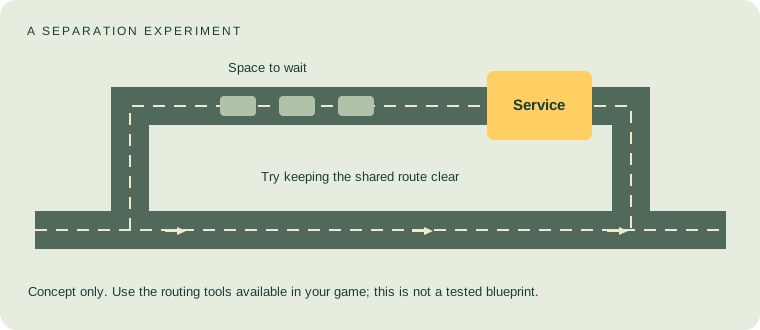
A useful experiment is to give a waiting queue space away from the route other vehicles need to use. Sketch the paths first: arrivals, service customers, deliveries and departures. Mark where those paths compete for the same space.
Try moving one conflict at a time, using only the routing options available in your current build. Leave an obvious route out. Do not assume that a real-world one-way design or a diagram on this site maps directly to the game's tools.
Judge the result by completed trips
A shorter-looking queue is not enough evidence on its own. Check whether more vehicles actually finish their visit and whether a new queue appears elsewhere. Use the same scenario and a similar observation window.
If several changes are needed, save each working stage. That gives you a way to undo the last experiment without losing the earlier improvement.
- Before: note the queue's origin and downstream exit condition.
- Change: adjust a single connection or conflicting route.
- After: watch complete trips and look for displaced congestion.
- Decision: keep, revise or revert the change.
When a layout issue may be a bug
If a short, visibly connected route repeatedly fails, reduce the problem to the smallest example you can reproduce. Save the game, note the version and scenario, and check current Steam discussions before assuming the same issue affects everyone.
A useful report includes the exact construction sequence, what you expected, what happened, and a screenshot that shows both ends of the route. Do not treat a forum title alone as proof of a confirmed bug.
READY FOR THE NEXT CHANGE?
Your quick checklist
Tick these off while you inspect your save. Checks are temporary.
Sources & limits
- Car Park Capital · official Steam news & developer logs ↗Official developer descriptions · reviewed 2026-10-11
Launch announcement (October 9), Devlog 2 (June 5), and Devlog 1 (January 6). Pre-release descriptions can change; they do not establish exact launch-version balance.
- Car Park Capital · Steam community discussions ↗Community discussion hub · reviewed 2026-10-11
A place to check current issues and report reproducible problems. Individual player reports are not treated as confirmed mechanics.
Reviewed on 11 October 2026. Pre-release descriptions can change. These suggestions have not been tested in a played save. Full editorial policy.